Article
Buy Telegram Members: A Practical Guide for 2026
Learn how to buy Telegram members strategically, compare real and low-quality members, choose a reliable provider, and combine paid growth with organic strategies.
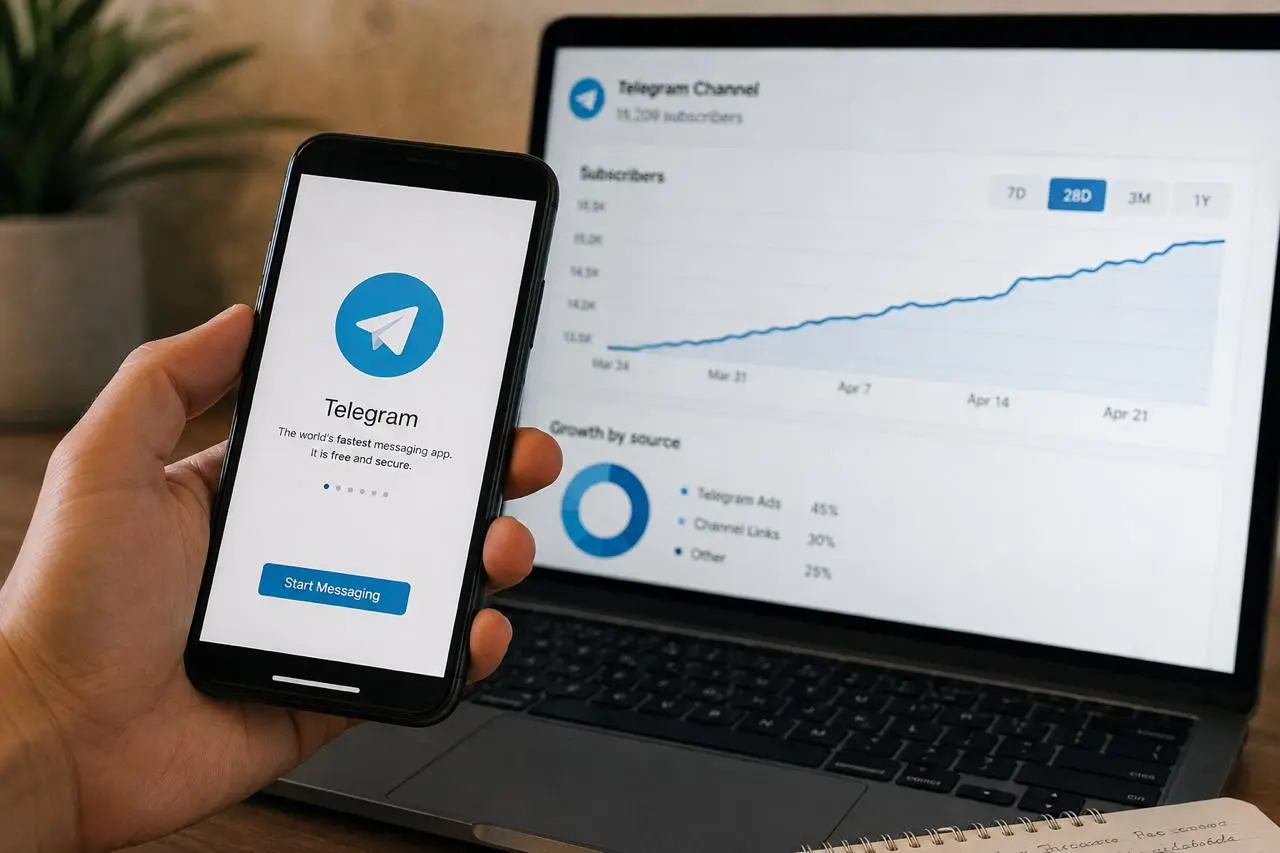
I've looked at a lot of new Telegram channels over the years, and the same thing keeps happening. The owner does the hard part reasonably well. The posts are decent, the niche is clear, the schedule is regular. Then they share the link, and almost nobody stays.
The problem usually isn't discovery. It's the moment right after discovery. Someone taps the invite link, sees 47 subscribers and a post with 12 views, and closes the app. They never read a word of the content. The channel got its chance and lost it in about two seconds.
That gap is the reason people buy Telegram members. Not because a number is magic, but because a very small number actively works against you while you're trying to build. A channel needs to look like a place other people already decided was worth joining.
This guide covers what buying members actually does, what it doesn't do, how to tell the difference between member types that look identical on a pricing page, and how to fit paid growth into a plan that still works if you stop buying. I'm going to be direct about the limits, because pretending they don't exist is how people waste money.
What Does It Mean to Buy Telegram Members?
Buying Telegram members means paying a service to add subscribers to your channel or participants to your group. You submit your public Telegram link, choose a package, and the provider delivers accounts over a defined window.
Two distinctions matter before you order anything.
Channels and groups behave differently. Channels are broadcast tools, and according to Telegram's FAQ a channel can have an unlimited number of subscribers. Groups are conversational and support up to 200,000 members. A channel subscriber receives your posts. A group member sits inside a chat where other people can see them, message them, and notice when they never say anything. Group campaigns are more visible and generally need more care.
Providers acquire members in different ways, and they don't all tell you which way. Some run promotional campaigns through partner apps and reward networks where real users see your channel and choose to join. Some deliver from pools of accounts of varying quality. Some use automated accounts that inflate the counter and nothing else. These methods produce very different results, and they're often sold under similar names.
That's why "buy Telegram members" is not one product. It's a category, and the category contains things that behave almost nothing alike.
Why Channel Owners Buy Telegram Members
The honest answer is social proof, but that phrase gets used so loosely it stops meaning anything. Here's what it actually does.
It fixes the first impression. New visitors judge a channel before reading it. Member count is the first number they see. There's a threshold below which a channel simply reads as abandoned, and no amount of good writing overcomes it, because the writing doesn't get read.
It gives promotion something to land on. If you're about to run cross-promotion, Telegram Ads, or a launch post, sending traffic to a nearly empty channel wastes it. The same traffic converts better when the channel already looks established. This is the use case I find most defensible: paid members as preparation for other marketing, not as a substitute for it.
It shortens the least productive phase. The first thousand subscribers are the slowest and the least rewarding to chase manually. Skipping some of that lets you spend the time on content instead.
It supports partnership and advertising conversations. Channel owners evaluating a cross-promo, and advertisers evaluating a placement, both look at size first. It isn't the only thing they look at, which I'll get to.
It sets a visible target. Telegram's own ad revenue sharing program requires a public channel with at least 1,000 subscribers before the owner is eligible for a share of ad revenue. When a threshold like that exists, people reasonably want to reach it faster.
If you want a longer treatment of the motivations, we cover why channel owners choose to buy Telegram members separately.
One mistake I see constantly: treating the member count as the growth strategy. It isn't. It's a starting condition. A bigger number improves the first impression and buys you attention. It cannot rescue a channel that has nothing worth reading.
Can Buying Telegram Members Actually Help a Channel Grow?
Yes, conditionally, and the conditions are the whole answer.
Purchased members reliably deliver:
a larger visible audience
a stronger first impression for organic visitors
a more credible profile when pitching partners or advertisers
a better conversion environment for other promotion you're already running
Purchased members do not reliably deliver:
post views
reactions or comments
sales or signups
loyal community members who stick around for years
Those outcomes depend on member quality and, more than anything, on your content.
Consider two hypothetical channels. The first has 80 members and genuinely excellent posts. It looks brand new, and most visitors leave before reading. The second has 3,000 relevant members and posts that get 400 to 600 views each. The second one converts visitors far better, because the numbers are consistent with each other.
Now a third case, which is the one to avoid. A channel with 50,000 members and 90 views per post. Every visitor who scrolls does the division. That channel looks worse than the 80-member one, because it looks dishonest rather than just small.
The lesson isn't "don't buy members." It's that the member count has to stay in a believable relationship with the activity around it. We go deeper into that in the article on how purchased members affect your channel's analytics.
Real Telegram Members vs Bot Members
This is where most of the money gets wasted, because the labels are inconsistent across providers and the packages look interchangeable.
Two things to keep in mind. First, no two providers define these terms identically, so always read the actual package description rather than trusting the category name. Second, "real" does not mean "engaged." A real person can join your channel and never open it again. Real refers to the account being a genuine human account, not to their interest in your niche.
Member type | What it means | Main advantage | Main limitation | Best use |
|---|---|---|---|---|
General real members | Genuine accounts, no niche filtering | Believable profile, better retention than bots | Little to no interest in your specific topic | Building baseline social proof on a new channel |
Targeted members | Real accounts filtered by country, language, or interest | Highest chance of some genuine engagement | Costs more, slower delivery, smaller available volume | Channels selling something or serving one region |
Premium-account members | Accounts carrying a Telegram Premium badge | Visibly higher-quality member list | Premium status still doesn't guarantee interest | Channels where the member list is browsed by visitors |
Bot / inactive accounts | Automated or dormant accounts | Cheapest, fastest counter increase | No views, no engagement, higher removal risk | Very limited; mainly crossing a visual threshold |
Low-retention members | Any type delivered with a known drop rate | Low cost per delivered member | Count falls noticeably within days or weeks | Short-term campaigns where the peak matters |
If you want a practical way to audit what you actually received after delivery, the breakdown of the engagement difference between genuine and automated accounts is more useful than any provider's description.
What Are Targeted Telegram Members?
Targeting means filtering who gets added, usually by country, language, or broad interest category. Not every provider supports every dimension, and the narrower the filter, the smaller the pool and the slower the delivery.
Relevance matters more than volume when your channel has a job to do. A Persian-language trading channel with 2,000 Iranian members is in a better position than the same channel with 20,000 members from countries where nobody reads Persian. The second channel has a bigger number and a worse business.
Where targeting genuinely helps:
regional e-commerce and local services
language-specific content
channels that will eventually sell ad placements, since advertisers ask about audience geography
anything where you plan to measure conversions rather than just subscribers
Where it matters less: general entertainment, news aggregation, or a channel where you only need the profile to stop looking empty before a launch.
Targeting improves the odds of engagement. It does not create customers. Anyone promising that a targeted package converts into buyers is selling you something that doesn't exist.
How to Choose a Provider
Before ordering anywhere, work through this list.
Member quality and honest labeling. The package should say what you're getting. Vague wording usually means the answer is unflattering.
Targeting options. Does the provider actually support country or language filtering, or just claim it?
Delivery pacing. Gradual delivery looks more natural than a vertical spike. Ask whether pacing is configurable.
Retention and replacement policy. What happens if members drop? Is there a refill window, and how long? A provider with no policy has no accountability. We discuss the tradeoffs in the piece on non-drop Telegram members.
No password or account access. This one is non-negotiable. A legitimate Telegram member service needs your public channel link and nothing else. Any provider asking for your phone number, login code, or account credentials should be closed immediately.
Reachable support. Not a chatbot. Someone who can answer a question about an order that stalled.
Transparent pricing. Per-thousand pricing you can compare, without a maze of upsells.
A small test order. The single most useful thing you can do. Buy the minimum, watch the retention for two weeks, then decide.
Cheapest almost always means bot accounts with heavy drop. If a price is far below everyone else, that difference is the product.
How Many Telegram Members Should You Buy?
There's no universal formula, and anyone who gives you one is guessing. The right amount depends on your current count, channel age, posting frequency, niche, existing organic growth rate, campaign goal, and budget.
What I'd actually think about: the number should look plausible next to your posting history and your views.
Some illustrative examples, clearly hypothetical:
A channel with 100 members and 15 posts published. Moving to 500 or 1,000 is a reasonable first test. Moving to 100,000 produces a profile that no visitor believes.
A channel with 5,000 members and 1,500 views per post, preparing for a product launch. Adding a few thousand ahead of the launch is consistent with what's already there.
A channel with 200 members and three posts. This one shouldn't buy anything yet. Fix the content first.
The pattern is proportionality. Growth that's ten times your existing base, delivered in a day, looks like what it is. Growth that roughly doubles or triples a modest base over a reasonable window doesn't.
Start small enough that a bad provider only costs you a test budget.
New Channels vs Established Channels
If your channel is new
Buying members can make sense, but only after the channel is ready to be seen. Before ordering:
profile photo set
clear, specific description that says who the channel is for
at least eight to ten real posts published
a pinned post that explains the value in one screen
a defined niche you can state in one sentence
a posting schedule you can actually keep
A channel with paid members and three posts converts worse than a channel with no paid members and thirty posts. The members arrive at an empty room.
If your channel is established
Different situation, different questions. Established channels use member campaigns to accelerate a plateau, support a specific launch, extend into a new region, or strengthen their position before advertiser conversations.
When I look at an established channel before suggesting anything, I don't start with how many members the owner wants. I look at posting frequency over the last month, average views per post, the current view-to-subscriber ratio, whether growth has stalled or is still climbing, and where the next organic members are supposed to come from. If views are already weak relative to the member count, adding members makes the ratio worse, not better. That channel needs content work and visibility, not more subscribers.
For the organic side of the equation, our guide on growing a Telegram channel covers the fundamentals.
How Buying Telegram Members Works
At TelegramMember the process is three steps, and it's worth stating plainly because the fear around this topic is mostly about account safety.
Choose your service and package. Members, and separately views or reactions if you want them, sized to your channel.
Submit your Telegram link and complete checkout. Public channel or group link, package confirmation, secure payment.
Track delivery. Progress and status are visible in your order dashboard.
We never ask for Telegram passwords or account access. There is no step where you hand over credentials, no login code, no session. If any provider anywhere asks for these, that's not how member delivery works, and you should treat the request as an attempted account takeover.
After delivery starts, keep posting. That's the part people skip.
What Happens After You Buy
Realistic expectations, in order:
The member count rises over the delivery window.
The channel profile reads as more established to new visitors.
Organic visitors are more likely to stay and browse before deciding.
Post views may rise slightly, or barely at all, depending on member quality.
Some members leave. The rate depends on the service tier and the member type.
Engagement changes, if it changes, over weeks rather than hours.
The last point is the one people get wrong. They check the views the morning after delivery, see no change, and conclude the order failed. Member campaigns change the conditions your channel operates under. They don't change your content's performance on their own. Judge the result after a month of consistent posting, not the next day.
If you were promised guaranteed engagement, you were promised something no provider can deliver. We wrote about that and several related claims in common myths about buying Telegram members.
How to Reduce Member Drop-Off
Retention is partly a provider question and partly yours. The provider controls account quality and delivery method. You control everything the members experience after they arrive. If your channel is already losing subscribers before you order anything, fix that first. Buying into a leaky channel only makes the leak more expensive.
What helps:
Post before and during delivery. New members landing on a channel whose last post is three weeks old have nothing to hold them.
Keep a schedule. Irregular posting trains people to mute you, and muted members are one step from leaving.
Match content to audience. If you ordered members from a region, publish something relevant to that region.
Don't spam. Fifteen posts in an hour drives out real members faster than any drop rate.
Keep the identity clear. Consistent name, photo, and description. A channel that changes topic confuses people into leaving.
Pin something useful. Give new arrivals a reason to scroll.
Choose higher-retention services when the budget allows. The cheapest tier and the highest drop rate are usually the same tier.
A provider can deliver members who intended to stay. Only your content makes them want to.
Buying Members vs Organic Growth
This gets framed as a rivalry, which is the wrong frame. They solve different problems.
Factor | Buying members | Organic growth |
|---|---|---|
Speed | Hours to days | Weeks to months |
Cost | Predictable, per thousand | Time, content production, promotion budget |
Control | High, you choose volume and pacing | Low, depends on reach and luck |
Effort | Minimal after ordering | Continuous |
Scalability | Scales with budget | Scales with audience and content quality |
Social proof | Immediate | Slow to accumulate |
Engagement potential | Limited, varies by member type | High, members chose to be there |
Long-term value | Supporting, fades without follow-up | Compounding |
Read the rows across. Buying is fast, controllable, and shallow. Organic is slow, uncontrollable, and deep. Neither one is a strategy by itself.
The combination that works: paid members establish the baseline and make the channel presentable, organic promotion brings in people who actually care, and content converts both into an audience that stays. Remove any of the three and the other two underperform.
Does Buying Members Increase Views and Engagement?
Member count and post views are separate metrics, and treating them as the same thing causes most of the disappointment in this industry.
Every Telegram member has to open the app, open your channel, and read the post for the view to register. Buying members doesn't make that happen. It only enlarges the pool of accounts that could theoretically do it.
If visibility is your actual goal, work on it directly:
write headlines that survive a notification preview
publish consistently enough that people expect you
add post views to launches and pinned announcements where the first impression matters most
add reactions to give posts visible engagement signals
promote outside Telegram, where most of your future members currently are
Members, views, and reactions serve different functions. A channel that has all three in proportion looks coherent. A channel with one of them at scale and the others near zero looks off, and visitors notice.
I'd also avoid any claim that buying members manipulates a Telegram ranking algorithm. Telegram doesn't publish one for channels the way other platforms do, and I'm not going to invent mechanics to make the pitch sound better.
Buying Members and Advertisers
Advertisers evaluating your channel look at member count, average views per post, engagement, niche, audience geography, and posting consistency. Member count opens the conversation. The rest closes it.
Compare two channels pitching the same advertiser. One has 50,000 members and 100 views per post. The other has 10,000 members and 3,500 views per post. The second one gets the deal, every time, and probably at a better rate. The advertiser is buying attention, and the second channel demonstrably has it.
Telegram's own monetization program reflects this. The 1,000-subscriber threshold is an entry requirement, but the revenue is tied to ad views in your channel, not to how many people subscribed and left. If monetization is your actual goal, our walkthrough of Telegram ad revenue sharing eligibility and setup covers the requirements and payout mechanics in full.
So member growth helps you qualify for conversations. It doesn't win them. Keep the ratio healthy.
Common Mistakes
Ranked roughly by how often I see them and how much they cost.
Buying on price alone. The cheapest package is cheap because of what's in it.
Buying too many at once. A vertical line on your growth graph is visible to everyone including you.
Ignoring member type. Ordering "members" without knowing which kind, then being surprised by the result.
Buying for a channel with no content. The most expensive mistake, because nothing about the order can work.
Expecting engagement to follow automatically. It doesn't, and this expectation causes most of the complaints in this industry.
Never checking retention. Order, walk away, don't measure, can't learn.
Stopping all other marketing after ordering. The order was supposed to make the rest of your marketing work better, not replace it.
Skipping targeting when the channel actually needs it. Regional and language-specific channels lose the most here.
Choosing a provider with no support. Something will need clarifying eventually.
Handing over account credentials. Never do this. There is no legitimate reason for a member service to need them.
Mixing several cheap providers without tracking which did what. When retention collapses, you have no idea which order caused it.
Is Buying Telegram Members Safe?
I won't tell you it's zero risk, because that's not a claim anyone can honestly make about a third-party service on a platform they don't control.
Here's the accurate version. Telegram's Terms of Service prohibit spam and scam activity. They don't contain a rule specifically about paid member growth. But Telegram does act against inflated audiences in some cases: the terms state that channels that mislead users into joining through giveaways later refunded through a third party may be terminated or labeled as scam and removed from search, and that subscribers gained that way may be removed. Telegram also runs continuous anti-spam enforcement against automated accounts, and accounts removed from the platform disappear from your count.
What that means practically: risk scales with how artificial the delivery is. Bulk bot accounts delivered instantly carry more risk than real accounts delivered gradually. Nothing about that is controversial.
To keep risk low:
use a provider with a track record and reachable support
prefer gradual, paced delivery over instant spikes
never share passwords, login codes, or account access
keep the channel genuinely active throughout
avoid stacking automation tools you don't understand
keep member growth proportional to your views and posting
Do those things and buying members behaves like any other paid acquisition channel. Ignore them and you're building a profile that doesn't hold up to a glance.
Checklists
Before you buy
[ ] Profile photo and channel name finalized
[ ] Description states clearly who the channel is for
[ ] Eight or more useful posts already published
[ ] Pinned post explaining the channel's value
[ ] Niche defined in one sentence
[ ] Posting schedule you can sustain
[ ] Decided between general, premium, or targeted members
[ ] Budget set for a test order, not the full campaign
[ ] Provider checked against the criteria above
After you buy
[ ] Keep publishing on schedule
[ ] Continue organic and cross-channel promotion
[ ] Check member count weekly for drop
[ ] Watch views per post and the view-to-member ratio
[ ] Note which posts perform and produce more of those
[ ] Add views or reactions to key posts where it makes sense
[ ] Evaluate the provider after 30 days before ordering again
Buying Telegram Members From TelegramMember
I work on the SEO and product side at TelegramMember, so treat this section as informed rather than neutral. Here's what I'd point to if you're comparing.
We only do Telegram. Members, post views, and reactions, for channels and groups, with nothing else diluting the focus. The company has been operating for over five years and serves customers across more than 40 countries, with the current order and customer totals published on our homepage.
The ordering flow is the three steps described above: choose a package, submit your channel link, complete secure checkout, then track delivery in your dashboard. We never request Telegram passwords or account access, and delivery pacing is designed to produce growth patterns that look normal rather than sudden. Support is handled by people who work on Telegram campaigns daily, and there's an API if you're running growth for multiple channels.
You can compare the current Telegram member packages directly, including standard channel members and Premium-account members.
What I won't tell you is that any of this guarantees engagement or growth. It gives you a reliable starting condition. The channel is still yours to build.
A Practical Growth Framework for 2026
Eight stages, in order. The order matters more than the individual steps.
Build the channel properly. Name, photo, description, pinned post, defined niche.
Publish before you promote. Enough posts that a visitor can judge the channel.
Establish a baseline audience. This is where a first member campaign fits, sized proportionally.
Post consistently. Whatever schedule you can hold for three months.
Add organic promotion. Cross-promotion, other platforms, communities where your audience already is.
Reinforce key posts. Views and reactions on launches, announcements, and pinned content.
Analyze. Telegram's built-in statistics show view rates, growth, and where subscribers came from. Read them monthly.
Repeat what worked, cut what didn't. Including the provider, if the retention data says so.
Buying members occupies stage three and occasionally stage six. It's one component in a system. Treated as the whole system, it produces a channel with a large number and nothing behind it, which is worse than where you started.
Frequently Asked Questions
What does it mean to buy Telegram members? It means paying a service to add subscribers to your channel or participants to your group. You provide the public link, choose a package, and the provider delivers accounts over an agreed window.
Is it worth buying Telegram members? It's worth it when your content is ready and the small member count is holding back conversion. It's not worth it when the channel has little published content, because the members arrive at nothing.
Can I buy real Telegram members? Yes, real-account packages exist. Just remember that "real" describes the account, not the person's interest in your topic. A real member can join and never open the channel again.
What's the difference between real and bot Telegram members? Real members are genuine accounts with some potential to view content. Bot or inactive accounts only increase the counter, contribute no views, and are more likely to be removed by Telegram's anti-spam systems.
Will buying Telegram members increase engagement? Not automatically. Members can view posts, but whether they do depends on member quality and your content. Member count and engagement are separate metrics and should be planned separately.
How many Telegram members should I buy? Enough to look proportional to your current size and activity. For a channel with a few hundred members, a first order in the hundreds to low thousands is a reasonable test. Avoid growth that multiplies your base overnight.
Is it safe to buy Telegram members? Risk depends on delivery method and account quality. Gradual delivery of real accounts from a reputable provider carries less risk than instant bulk bot delivery. No one can honestly promise zero risk.
Will purchased members leave? Some will. The rate depends on the service tier and member type, and on whether your channel gives them a reason to stay. Ask about the retention and replacement policy before ordering.
Can I combine purchased members with organic growth? Yes, and that's the approach I'd recommend. Paid members establish the baseline, organic promotion brings in people who care, and content converts both.
Can I buy targeted Telegram members? Targeting by country, language, or interest is available from some providers. Narrower targeting means slower delivery and higher cost, and it's most worthwhile for regional, language-specific, or sales-focused channels.
Should a new Telegram channel buy members? Only after the channel is presentable: profile complete, niche clear, and several useful posts already published. Buying before that wastes the order.
Does TelegramMember require my Telegram password? No. We only need your public channel or group link. We never ask for passwords, login codes, or account access, and no legitimate member service should.
Related articles
How to Combine Organic Growth with Buying Telegram Members for Maximum ROI in 2025

How to Choose the Right Service for Buying Telegram Premium Members
Buy Telegram member (Real and Cheap)
Why should I Buy Telegram members

How To Buy Telegram Premium Members?
Telegram Growth in 2025: How to Buy Members and Increase Post Views Effectively
Comments
No comments yet. Be the first to share your thoughts.