Telegram has become one of the most important platforms for shaping public opinion and individual decisions in conflict zones around the world. This is because digital communication has become the backbone of modern warfare and crisis response. The messaging app’s strong encryption, ability to work well even when the network is bad, and lack of content moderation have made it both a vital source of accurate information and a dangerous tool for spreading false information.
Telegram channels are the main way for people to get real-time news, citizen journalism, and community coordination, from the battlefields of Ukraine to the streets of Tehran during civil unrest. But this same openness and freedom give state actors, extremist groups, and bad actors new ways to change public opinion through complex propaganda campaigns and fake content.
The platform’s dual nature makes it hard for users to find their way through crisis situations, where the difference between true information and carefully crafted false information can mean the difference between life and death. Anyone who wants to understand how modern conflicts work and how information warfare works needs to know how data moves through Telegram’s ecosystem and affects how people act.
Why Telegram Matters in Conflict Zones
Telegram is popular in war zones because it has a unique mix of technical features and a philosophical approach to free speech. The platform’s end-to-end encryption keeps private messages safe even when governments try to listen in on or intercept civilian communications during times of unrest or military operations.
The app’s amazing ability to work well in bad network conditions makes it very useful in places where traditional communication infrastructure has been damaged or intentionally broken. Telegram works well even when the internet connection is slow or not always available, unlike many other social media sites that need fast connections. This means that important information can still get through when other ways of communicating fail.
Telegram stands out from its competitors in high-stakes situations where sharing information quickly can save lives or stop disasters. The platform can handle big files, like high-resolution photos and long video clips, which lets people share important proof and documents that might be important for journalists, international observers, or humanitarian groups.
Telegram plays a key role in many conflict zones, as shown by real-life examples. In the ongoing war in Ukraine, both military units and civilians use Telegram channels to plan evacuations, share updates on artillery positions, and keep morale up through community support networks. In the Middle East, activists and protesters use the platform to plan protests, keep track of human rights abuses, and talk to each other safely even though the government is watching them.
Conflicts in Central Asia have also shown how important Telegram is as a way to communicate that goes beyond traditional media. When traditional news sources are censored or can’t be accessed, Telegram channels are often the main source of information for people in the area and international observers who want to understand how things are changing quickly.
The Dual Role of Telegram – Data and Disinformation
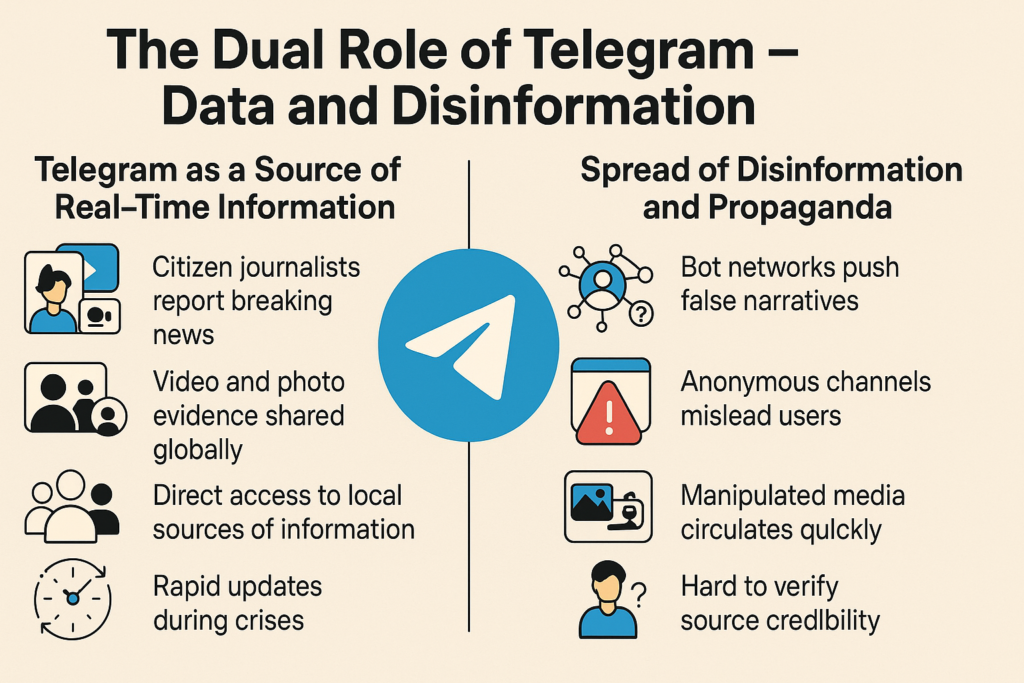
Telegram as a Source of Real-Time Information
Telegram has made journalism more accessible to everyone, which has changed the way breaking news comes out of war zones. Citizen journalists with smartphones can instantly send live video, eyewitness accounts, and ground-truth observations to people all over the world without the need for traditional media gatekeepers or editorial filters.
Telegram is a great way to share video and photo evidence of events as they happen. These pictures and videos often become very important pieces of evidence for international investigations, human rights groups, and court cases because they show things that professional journalists might not be able to see safely.
When information goes through a lot of middlemen, it can take longer and be less accurate. Direct access to local sources gets rid of a lot of these problems. Community leaders, military personnel, medical workers, and regular people can all share their thoughts and experiences right away. This creates a rich tapestry of firsthand accounts that gives depth and context that traditional news coverage often lacks.
Telegram’s instant messaging feature makes it possible to quickly respond to new threats, coordinate humanitarian aid, and get real-time updates on changing security conditions. This flow of information has been very helpful for planning evacuations, sharing resources, and keeping people who are affected aware of what’s going on.
Spread of Disinformation and Propaganda
But the same things that make Telegram great for sharing real information also make it a great place for propaganda and disinformation campaigns. Government agencies, intelligence services, and extremist groups have come up with clever ways to use the platform’s wide reach and trustworthiness to further their political goals.
Telegram is full of bot networks and anonymous channels that spread carefully crafted false stories meant to sway public opinion, cause confusion, or discredit other points of view. These automated systems can make some messages louder while making others quieter, making it seem like everyone agrees on certain interpretations of events.
Edited videos, fake audio recordings, and doctored photographs are all examples of manipulated media that spreads quickly through Telegram channels. These videos and recordings often gain credibility when they are shared and endorsed by sources that seem to be independent. Because the platform focuses on sharing and forwarding content, it is especially vulnerable to viral misinformation campaigns.
In places where many conflicting stories compete for attention, it can be very hard to check trust. This is because it can be hard to tell the difference between real sources and fake accounts or compromised channels that have been taken over by bad actors.
How Data Shapes User Behavior in Conflict Zones
The psychological effects of constantly seeing conflict-related information on Telegram have a big effect on how people think and make important decisions in times of crisis. Statistics about casualties, graphic images, and urgent updates can make people feel things that either bring people together to take action or make them too scared and unsure to do anything.
Reports of casualties and updates from the battlefield in real time can cause strong emotional reactions that affect everything from decisions about evacuating to political loyalties. When users get immediate alerts about attacks, victories, or losses, these updates put psychological pressure on them to act quickly, which can mean they don’t have enough time to think things through or check the accuracy of the information.
When people react to shared content in Telegram groups and channels, those reactions add up to form a community sentiment. When people comment on, react to, and share posts, they create collective narratives that can have a big impact on group decision-making and social cohesion.
The constant stream of updates can overload users with information, which can make it harder for them to think critically and make them more likely to believe things that support their current fears or beliefs. This mental burden often makes people make decisions based on how they feel rather than carefully thinking through complicated situations.
How Disinformation Influences User Decisions
Strategic disinformation campaigns are meant to affect choices about evacuation routes, safe zones, political allegiances, and how communities respond to new threats at key times in conflict situations. People can get into dangerous situations or not take the steps they need to protect themselves if they get false information about security conditions.
Disinformation manipulation is especially dangerous when it comes to decisions about migration and displacement. Fake news about conditions in refugee camps, how to cross the border, or safety in possible destination areas can change people’s lives and those of their families and communities.
Political polarization gets worse when false information campaigns take advantage of already existing social, religious, or ethnic tensions in the groups they target. False stories about how the government responded, how international aid was given out, or what different community groups did can make conflicts worse and make it harder to bring people back together.
When false information erodes trust between community members, local leaders, and institutions that are necessary for survival and recovery during times of crisis, social cohesion breaks down. These divisive effects can last long after the fighting is over, making it harder to rebuild and heal after the war.
Case Studies – Telegram in Global Conflict Zones
The war in Ukraine is a great example of how Telegram can be used in two ways in modern conflict. Ukrainian government officials, military leaders, and civilian volunteers use official channels to work together on defense, share accurate battle news, and keep the public’s spirits up. At the same time, Russian information operations use the platform to spread false flag operation claims, contradictory stories, and propaganda meant to weaken Ukrainian resistance and international support.
Conflicts in the Middle East show how Telegram works in different cultural and political settings. During the protests in Iran, activists used encrypted channels to plan protests, share information about what the police were doing, and record human rights abuses. But at the same time, accounts linked to the government spread false information to discredit protest movements and make harsh security responses seem reasonable.
The Syrian civil war communications show how the platform works in complicated conflicts with many parties fighting for control of the story. Different groups set up competing channels that said they were representing real civilian voices but were really serving partisan political or military goals. This made it hard to know what was really going on on the ground.
There have been complicated disinformation campaigns on Telegram that have used Central Asian border disputes to stir up ethnic tensions and justify military action. False reports about incidents across borders, fake casualty numbers, and false claims about violations of territory have all made conflicts worse that could have been settled through diplomacy.
The Challenges of Verifying Information on Telegram
Telegram’s minimal moderation approach means that false information can spread unchecked alongside real reports. This is different from major social media sites that use algorithmic content filtering and fact-checking systems. Without regular checks, it’s very hard for users to tell the difference between trustworthy sources and well-planned disinformation campaigns.
There are a lot of anonymous channels out there that don’t have to show where their money comes from, what their political views are, or what their goals are. Users often can’t tell if the sources of information are reliable or what their motives are. This can lead to propaganda channels getting a lot of followers by pretending to be real news outlets or grassroots groups.
When there is an active conflict, it is almost impossible to check facts because professional journalists and verification groups may not be able to get to the areas that are affected or find reliable sources to confirm or disprove specific claims. Often, information spreads faster than efforts to verify it, which lets false stories become established before corrections can be made.
It can be hard to cross-reference information sources when different channels share similar content that may come from one or more original sources that aren’t always reliable. The platform’s forwarding mechanisms can make it look like there is independent confirmation when there isn’t, when in fact multiple channels are using the same underlying information.
Balancing Free Speech and Misinformation Control
Telegram’s dedication to free speech and minimal content moderation is based on philosophical ideas about communication freedom that are especially important when governments are cracking down on dissent or censoring content. This method has given dissidents, journalists, and human rights activists living under oppressive governments important ways to talk to each other.
But the same freedom that protects free speech also makes it possible for advanced disinformation campaigns to hurt democratic processes, incite violence, and sway public opinion during important times. One of the biggest problems that digital communication platforms face is the tension between protecting free speech and stopping harmful false information.
Independent journalists and citizen media groups have come up with grassroots ways to fight false information, such as community-based fact-checking, source verification networks, and collaborative information sharing. These methods help find and disprove false stories before they can spread widely.
User education programs focus on teaching people how to think critically about the media so they can judge the reliability of sources, spot manipulation techniques, and get multiple points of view before accepting or sharing information during a crisis.
Implications for Businesses, NGOs, and Media Outlets
Organizations that work in areas of conflict must be able to use Telegram’s complicated information environment while still being credible and not accidentally getting involved in disinformation campaigns. To do this, you need to come up with advanced content strategies that put building trust in the community, verifying sources, and being open at the top of the list.
It is especially hard to manage a brand’s reputation when false information about business activities, the distribution of humanitarian aid, or political affiliations can quickly spread through Telegram channels and have a big effect on how people see the company and its security.
NGOs and humanitarian groups have a hard time staying neutral while still giving accurate information about what they do and the people they help. False claims about how aid is given out, what staff does, or what the organization’s goals are can make programs less effective and put people in danger.
Media outlets need to find a balance between the speed and reach of Telegram and the standards of professional journalism, which include checking sources, checking facts, and having editorial oversight. This often means agreeing to slower publication schedules to make sure the information is correct, even though they are competing with sources that care more about speed than reliability.
Future Outlook – Telegram’s Role in Global Crises
Integrating artificial intelligence into Telegram could help with some of its problems with false information by allowing for automated content analysis, source verification, and real-time fact-checking. But these same technologies could also be used to run more complex disinformation campaigns that are harder and harder to find and stop.
As governments around the world try to find a balance between national security and freedom of speech, the pressure on them to regulate more is growing. In the future, rules may change how Telegram works in different places, which could make the platform less effective and reach fewer people around the world.
New international cooperation frameworks are being created to deal with disinformation campaigns that cross borders and to coordinate responses to information warfare tactics that use platforms like Telegram. These efforts could result in new rules for how platforms should act and how users should be protected during times of crisis.
Technological advancements in encryption, content verification, and decentralized communication systems may impact the future balance of security, freedom, and information integrity on platforms, rendering current discussions regarding Telegram’s involvement in conflicts comparatively straightforward.
Conclusion – Telegram as Both a Lifeline and a Risk
Telegram’s role in conflict zones shows how complicated the relationship between technology and human conflict is in the digital age. The platform is both an important tool for survival, coordination, and documentation, and a powerful weapon for psychological warfare, social manipulation, and political destabilization.
Telegram’s dual impact shows how important it is to teach people how to read and understand media so they can find their way around places where truth and lies often look the same on the surface. Users need to learn advanced skills for judging the reliability of sources, checking claims against each other, and staying appropriately skeptical while still getting the most out of the platform’s legitimate uses.
As conflicts increasingly incorporate digital information warfare alongside traditional military tactics, understanding platforms like Telegram becomes essential for policymakers, journalists, humanitarian workers, and citizens who must operate effectively in complex information environments where the stakes of misinformation can be measured in human lives.
Telegram’s features will likely be used in more advanced ways for both good and bad reasons in the future. This means that anyone who is dealing with information during a crisis needs to be vigilant, think critically, and be honest. To get through these problems, you need to be both tech-savvy and know how people who want to use information for personal or political gain think and act.
Related items
Telegram officially crossed the incredible milestone of 1 billion active users in 2025, wh
Telegram is changing the way people talk to each other in a big way by adding xAI and its

Telegram is one of the messaging apps with the most features. It does a lot more than just