Article
Buy Telegram Members: How It Actually Helps Your Channel Grow
Buy Telegram members with realistic expectations: what purchased subscribers change, what they don't, and how to turn early momentum into real channel growth.
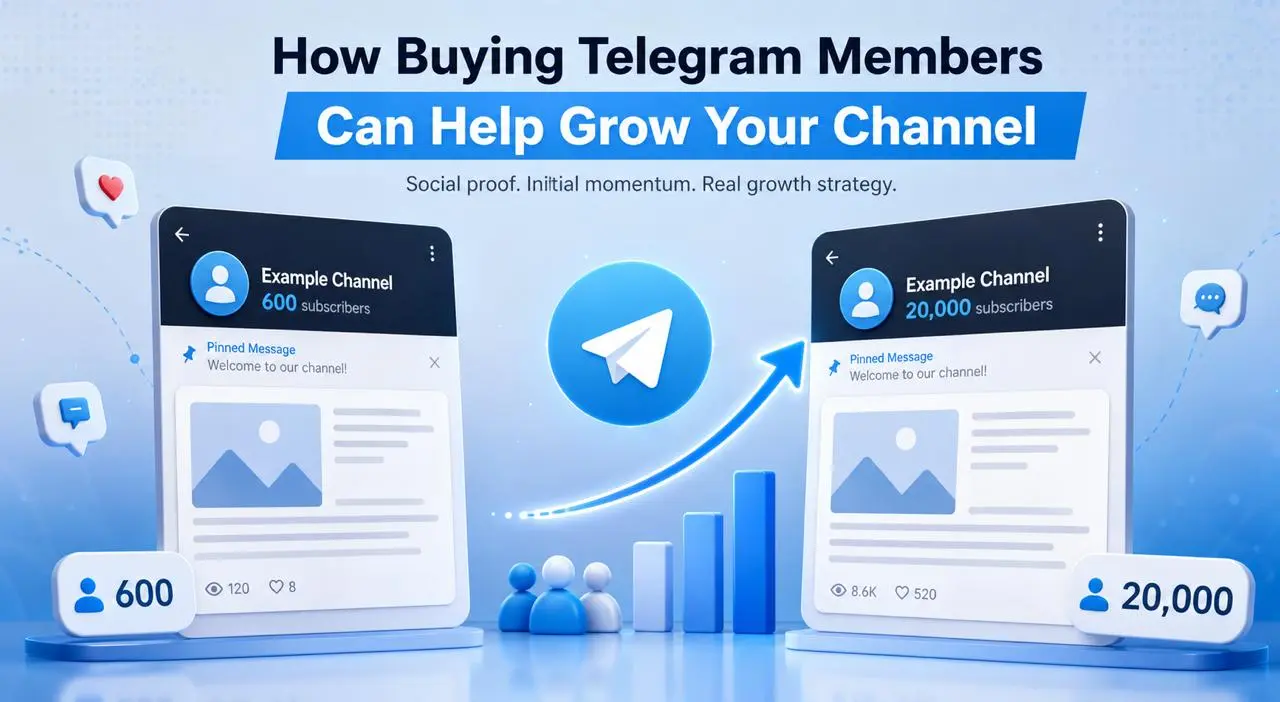
Two channels can publish the same post on the same day, worded almost identically. One has 600 subscribers. The other has 20,000. A person who lands on both of them from a forwarded link will usually make up their mind about which one is worth following before they finish reading the first message.
That reaction has nothing to do with quality. It is a shortcut. We all use it, on every platform, every day.
This is the part of Telegram growth that gets underestimated. People obsess over content calendars and posting times, and they are right to — but perception is doing quiet work in the background the whole time. A channel that looks small looks unfinished, and unfinished things feel risky to join.
So: does buying Telegram members actually help?
It can. But not in the way sellers usually describe it, and not in the way critics usually dismiss it. It doesn't flip a switch inside Telegram. It doesn't create readers. What it changes is the first number a stranger sees, and that number sits upstream of a decision they make in about two seconds.
Before we go further, it's worth separating five things that get blended together in almost every article on this topic:
The number — your visible subscriber count.
Perception — what a new visitor concludes from that number.
Engagement — whether anyone reads, reacts or forwards.
Distribution — how people find the channel at all.
Long-term growth — whether the channel compounds.
Buying members works directly on the first two. It touches the third and fourth only indirectly, through the decisions of real humans. And the fifth is earned. Keep those distinctions in your head for the rest of this article and everything below will make sense.
Why Subscriber Count Matters on Telegram
Telegram works differently from the feed-based platforms, and this is the thing most growth advice gets wrong when it's copied over from Instagram or TikTok. When you post to a channel, the post goes to your subscribers. There's no ranking layer deciding that 6% of them deserve to see it. Reach is a function of who has already joined.
Which means the join decision carries far more weight on Telegram than a follow does elsewhere. On Instagram, a follow is cheap and reversible and the algorithm will keep showing you the account anyway. On Telegram, if someone doesn't subscribe, they're gone. There's no second chance impression.
So what does a person actually use to make that decision? Usually four signals, in this order:
The subscriber count. The last few posts. Whether those posts have views and reactions. Whether the channel looks like someone is home — a proper name, a description, an avatar, a pinned message that explains what this is.
Subscriber count is first because it's the cheapest to process. It's a single number, and it functions as a proxy for "have other people already validated this?" That's social proof, and it isn't a marketing trick — it's how humans handle uncertainty when they don't have time to evaluate something properly.
I've seen channels with genuinely good writing struggle for months because a first-time visitor had no reason to trust them yet. The content deserved an audience. The presentation gave nobody a reason to take the risk.
There's a threshold effect too, and it's not linear. The difference between 90 and 300 subscribers barely registers. The difference between 300 and 8,000 changes the category of thing a visitor thinks they're looking at. Below a certain point a channel reads as someone's project. Above it, it reads as a publication. Where exactly that line sits depends on the niche — a specialist B2B channel with 2,000 subscribers looks credible, while a general news channel with 2,000 looks brand new.
One thing to be careful about: none of this means Telegram's systems reward you for a bigger number. Telegram does surface similar channels to users and does run search, but I have no evidence — and neither does anyone else selling you something — that your subscriber count is a ranking input you can buy your way into. The mechanism here is human, not algorithmic. That distinction matters, and I'd rather state it plainly than let you infer something that isn't supported.
What Buying Telegram Members Actually Does
Strip away the sales language and the effect is narrow and specific.
It raises your visible subscriber count. That's the direct, mechanical outcome. Everything else is downstream of what humans do when they see that number.
It gives the channel a base. A channel that isn't starting from zero is easier to promote, easier to pitch to a cross-promotion partner, and easier for a first-time visitor to take seriously.
It strengthens social proof. The next visitor arrives at a channel that looks like it already has an audience, which lowers the barrier to joining.
It changes how your other marketing performs. This is the underrated one. If you're about to run ads, do a partnership, or push a launch, the landing experience matters. Sending paid traffic to a channel that looks abandoned wastes the traffic. You can explore Telegram member packages sized for that kind of pre-campaign preparation.
Now the other side, stated just as plainly.
Purchased members do not read your posts. They do not react, comment, forward, or buy. They do not create a community. They do not make Telegram recommend you. They do not guarantee that organic subscribers will follow. And they certainly don't protect a channel that's breaking Telegram's rules.
I want to be honest about why I'm listing all of that in an article that is, ultimately, positive about buying members. Because the version of this pitch where purchased members magically produce sales is the version that makes people waste money. If you go in expecting a number and a stronger first impression, you'll get value. If you go in expecting an audience, you'll be disappointed, and you'll blame the wrong thing.
How Buying Members Can Create Initial Momentum
Momentum on Telegram is mostly psychological before it becomes mathematical.
A channel with 200 members feels like a private project — the kind of thing you'd expect to be run by one person who might stop next month. A channel with 10,000 feels like something with a team behind it, or at least a commitment. The posts can be word-for-word identical. The frame around them is different, and people react to the frame.
Once a channel crosses into "this looks established," a few small things start compounding. Cross-promotion partners answer your messages. People forward posts because forwarding something from a real-looking source doesn't cost them social capital. Visitors who arrive from those forwards convert at a slightly higher rate. None of these effects are dramatic on their own. Together, over weeks, they're the difference between a channel that grinds and a channel that pulls.
But I'd be overselling it if I implied the number does the work. It doesn't. It removes an obstacle. There's a real difference between removing friction and creating demand, and buying members only does the first.
I've also seen the opposite play out plenty of times: a channel buys a large package, the count jumps, and then nothing happens for six weeks because nobody publishes anything. The number went up. The channel didn't.
Buying Telegram Members vs Organic Growth
The framing of "paid versus organic" is a trap, because in practice they're not competing — they operate on completely different timescales and solve different problems.
Factor | Organic growth | Purchased members | Best use |
|---|---|---|---|
Speed | Slow; weeks to months before numbers move meaningfully | Fast; visible within the delivery window | Use purchased growth when timing is fixed (launch, campaign, partnership) |
Initial social proof | Builds gradually, often too slowly to help early | Immediate change to the visible count | Purchased growth is strongest at the very start |
Audience quality | High intent — these people chose you | Varies by provider; treat as base, not audience | Organic is what you actually monetise |
Engagement | Real reads, reactions, forwards, replies | Should not be expected | Never judge a member package by engagement |
Long-term sustainability | Compounds; each real subscriber can bring others | Static; retention varies and some drop-off is normal | Organic is the only thing that compounds |
Control | Limited — depends on demand you can't fully manufacture | High — you choose volume and pacing | Purchased growth gives you a dial you can turn |
Cost | Time, content production, promotion budget | Direct, predictable spend | Budget both; they're not substitutes |
Best role in strategy | The engine | The starter motor | Use one to start, the other to keep going |
The starter motor comparison is the one I keep coming back to. It's a real component, it does a real job, and the car doesn't move without it. It also isn't what makes the car go.
The strongest Telegram strategies I've seen don't choose. They use paid growth to compress the awkward early stage — the stage where nothing works because nothing has worked yet — and then spend everything else on the thing that compounds.
Why Member Quality Matters More Than the Number
This is the section I'd read twice if I were buying for the first time.
Ten thousand poor-quality members are not automatically better than three thousand solid ones. In some situations they're actively worse, because the profile of your channel starts to look inconsistent: a large count sitting next to very low view numbers is a signal that experienced people in your niche read immediately. Advertisers read it. Partners read it. Anyone evaluating your channel for a collaboration reads it.
The things that separate a good order from a bad one:
Source. Where the accounts come from determines almost everything downstream. This is also the part of the industry with the least transparency, which is why provider reputation carries real weight.
Retention. Some drop-off is normal in this industry and any provider claiming otherwise is telling you what you want to hear. What matters is the scale of it and whether the provider has a refill policy. Ask before you order, not after.
Delivery pacing. Gradual delivery produces a growth curve that looks like growth. A vertical line on the chart looks like exactly what it is. If you can choose pacing, choose gradual — especially on a small or new channel where the jump would be proportionally enormous.
Relevance and targeting. Where geo or language targeting is available, use it. A channel publishing in Persian with a member base that looks entirely Latin American is a mismatch that anyone paying attention will notice.
Volume relative to your current size. Going from 300 to 50,000 in a day is not a strategy, it's a costume. It also makes every subsequent metric look broken.
I'd genuinely rather see a channel build a sensible base and keep earning real subscribers than chase a huge number for one screenshot. The screenshot doesn't do anything. The base does.
It's also worth understanding what the different member types actually are before you spend anything, since "real" is used very loosely across this industry — we covered that ground in our guide to Telegram fake members and the alternatives.
And to be straightforward about our own position: TM sells member, view and reaction services, and we describe our delivery approach and pacing openly. Those are product claims, made by us. They aren't independently audited facts, and I'd tell you to treat any provider's self-description — ours included — as a starting point for questions rather than a conclusion.
What Happens After You Buy Telegram Members?
Here's where most of the value is won or lost. The order completing is the start of the work, not the end of it.
Step 1 — Make the channel look like it's run by someone. Name, avatar, description, pinned post explaining what the channel is and why someone should stay. This takes twenty minutes and it's the highest-leverage twenty minutes in the whole process.
Step 2 — Publish consistently, starting now. A visitor who scrolls up and finds the last post was eleven days ago has learned everything they need to know. Consistency beats volume: three good posts a week for two months does more than twenty posts in one weekend.
Step 3 — Make your important posts visible. Launch announcements, pinned explainers and campaign posts carry disproportionate weight because they're what new visitors see first. Telegram post views can be applied selectively to those posts rather than sprayed across everything.
Step 4 — Add reactions where they fit. Reactions are the cheapest visible engagement signal on the platform. They also look wrong when they arrive all at once, which is why delivery pacing matters — our guide on instant versus spread delivery explains the difference in practice.
Step 5 — Promote where your actual audience already is. Cross-promotion with channels in adjacent niches, your own website and email list, other social profiles, relevant communities. This is where genuinely interested people come from.
Step 6 — Keep organic acquisition running. Not as a phase you complete. As a permanent background process.
Step 7 — Watch the right numbers. Views per post relative to subscriber count, forwards, reaction rate, and the direction of your subscriber curve over 30 days. Telegram's built-in statistics panel covers most of this once your channel is past the minimum size.
One of the first things I look at after a member campaign isn't the count. It's what happened in the two weeks afterwards. If views per post are flat and the channel posted four times, the campaign was fine and the channel wasn't. That's a content problem wearing a growth problem's clothes.
How I Would Use Purchased Members on a New Telegram Channel
If someone handed me a brand-new channel tomorrow and a modest budget, this is the order I'd work in.
First, I'd set the channel up properly — before spending anything. Clear name, a description someone can understand in five seconds, an avatar that doesn't look like a placeholder, a pinned welcome post.
Second, I'd publish enough content that the channel has a body. Somewhere around eight to fifteen posts, so a visitor scrolling up finds substance rather than a launch announcement and silence. I won't pretend that number is scientific — it's just where the channel stops feeling empty.
Third, only then would I establish an initial member base. Buying members into an empty channel is the most common way to waste the money. The number brings people to the door; the content decides whether they walk in.
Fourth, I'd start posting on a fixed rhythm and hold it for at least a month without changing anything.
Fifth, I'd add views and reactions selectively — on the posts that matter, not on every message.
Sixth, I'd promote deliberately. Two or three cross-promotions with channels of comparable size, and every owned channel I control pointing at it.
Seventh, I'd measure at 30 and 60 days and adjust based on view rate rather than subscriber count.
On how many members to buy: I'm not going to give you a number, because anyone who gives you a fixed number without knowing your channel is guessing. It depends on where you're starting from, what's normal in your niche, how old the channel is, what you're trying to look like by a specific date, how much content you can sustain, and what you can afford.
The one heuristic I'd offer: your target should look plausible next to your content volume. A channel with twelve posts and 100,000 subscribers doesn't look successful. It looks staged.
Buying Members + Content + Views + Reactions
These four things get sold separately and marketed as alternatives, which confuses people. They're not alternatives. They occupy different positions in the same funnel.
Growth tool | Primary role |
|---|---|
Members | Establish the visible audience base and social proof |
Views | Make individual posts look read, especially launch and pinned content |
Reactions | Provide visible interaction signals on posts that carry weight |
Content | Create the actual reason to stay subscribed |
Organic promotion | Bring people with genuine interest |
Advertising | Buy targeted reach when you have something worth landing on |
The way I think about it: members answer "is this worth my attention?", views answer "does anyone actually read it?", reactions answer "do people like it?", and content answers "should I stay?"
A channel with a large member count and posts sitting at forty views has answered the first question and failed the second, and visitors notice the gap immediately. Balance across signals reads as real far more than any single number does. That's the practical case for combining Telegram reactions with views rather than buying members alone.
Content is the only one of these that keeps anybody. The rest determine how many people get far enough to find out whether your content is any good.
Telegram Boosts Are Different From Buying Members
These two get conflated constantly, including in older articles on this site, so let's separate them properly.
Telegram Boosts are an official Telegram feature. Telegram Premium subscribers receive boost slots and can assign them to channels and supergroups they want to support. As a channel accumulates boosts, it levels up, and each level unlocks additional capabilities.
According to Telegram's own documentation, the features tied to boost levels include the ability to post channel Stories — each boost adds one additional story per day to subscribers' story feeds — along with custom reactions, message accent colours, profile colours and emoji, custom emoji statuses, channel wallpapers, and at higher levels things like automatic translation for all users and the option to disable ads on the channel. Channel admins can also generate additional boosts by running Telegram giveaways, which is the platform-native way to acquire them.
Boosts are not purchasable as a growth service, and they can't be manufactured by adding subscribers. They come from real Premium accounts choosing to spend a limited slot on your channel, with a cooldown before that slot can be moved elsewhere. If you want to understand the Premium side of this properly, our guide to Telegram Premium covers what the subscription includes.
Buying Telegram members is something else entirely. It's a third-party service that increases your subscriber count. It is not connected to Telegram's boost system, it does not add boosts, and it does not unlock Stories, custom reactions or appearance customisation.
Two separate mechanisms, two separate outcomes. Anyone telling you that buying members will unlock Telegram's Premium channel features is either confused or hoping you are.
Telegram Boosts | Purchased members | |
|---|---|---|
What it is | Official Telegram feature | Third-party growth service |
Where it comes from | Premium users assigning boost slots; giveaways | A provider delivering subscribers |
What it changes | Channel level and unlocked features | Visible subscriber count |
Effect on features | Unlocks Stories, custom reactions, appearance options | None |
Effect on social proof | Minor and mostly invisible to casual visitors | Direct — it's the number people see |
When Buying Telegram Members Makes the Most Sense
It's not mandatory, and there are channels that never need it. But there are situations where it earns its cost more reliably than others.
Launching something new. The empty-room problem is real and it's the single clearest use case.
Repositioning an existing channel. A rebrand, a niche change, or a move from a personal project to a business channel — all of them benefit from the count matching the new ambition.
Preparing before you advertise. Paid traffic amplifies whatever it lands on. Make sure it lands on something.
Ahead of a partnership or cross-promotion. Bigger partners tend to check the number before agreeing to anything, whether or not they'd admit it.
Supporting a larger campaign where the channel is one component and needs to look consistent with everything else you're running.
Before a serious organic push, so that the traffic you're about to work hard for converts at a better rate than it otherwise would.
The common thread: it's most useful when you already have something worth arriving at, and the only thing missing is the confidence signal.
When Buying Members Is Not Enough
And the honest inverse.
If the content isn't good, buying members changes nothing except how many people are around to not read it. If you post irregularly, the count is the first thing that makes the irregularity obvious — a large subscriber number with a three-week gap looks worse than a small one. If the niche is wrong for Telegram, or your audience simply isn't on the platform, a bigger number doesn't relocate them. If you're doing no promotion at all, purchased members are the only members you'll ever have. If there's no engagement strategy — nothing that invites reactions, replies, discussion, or forwards — the channel stays a noticeboard.
And if you're buying purely for vanity, to have a number to show someone, you'll get exactly that and nothing more.
That's why I don't treat purchased members as a finish line. They're a starting position. The channels that get the most out of it are the ones that treat the delivery date as day one of the actual work.
Common Mistakes When Buying Telegram Members
Choosing purely on price. The cheapest option in this industry is cheap for reasons that will show up in your retention numbers.
Buying too aggressively. Enormous jumps relative to your current size look staged and distort every metric that follows.
Buying before the content exists. The most expensive mistake, because the money is spent driving attention to an empty room.
Expecting purchased members to engage. They won't. Building your plan around the assumption that they will is how disappointment gets manufactured.
Ignoring retention entirely. Ask about drop-off and refill policy before you order.
Never doing organic promotion. Paid growth without organic growth is a plateau with a receipt.
Treating subscriber count as the only KPI. View rate tells you more about channel health than the subscriber number ever will.
Using a provider you know nothing about. Support responsiveness before purchase is a decent proxy for support responsiveness after.
Buying and then abandoning the channel. Extremely common, and the reason a lot of people conclude that buying members "doesn't work."
How to Choose a Telegram Member Provider
The questions worth asking, roughly in order of how much they matter.
How is delivery handled, and can you control the pace? Gradual delivery options are a good sign. So is a provider that will slow an order down if you ask.
What happens if members drop? You want a clear answer about refill or replacement policy, in writing, before you pay. Some drop-off happens across this industry — the useful signal is whether the provider is upfront about it.
Is targeting available? Geo and language options matter if your channel isn't in English.
Can you reach support, and how fast do they reply? Test this before you order. Send a pre-sales question and time the response.
Is there order tracking? Being able to see progress rather than waiting blind is worth more than it sounds.
How does the provider talk about results? This is the one I'd weight most heavily. A provider promising guaranteed engagement, guaranteed organic growth, or immunity from platform enforcement is telling you they'll say anything. That should affect how much you believe the rest of it.
Payment security. Standard checkout, no requests for your Telegram password or account access. No legitimate service needs either.
For our part: TM runs member, view and reaction services with order tracking, structured delivery pacing and support that handles pre-sales questions. I'm describing what we do, not claiming a ranking. Compare us against others on the questions above and decide for yourself — that's the process I'd use, and it's the one I'd want a customer to use on us.
A Practical Telegram Growth Strategy for 2026
Here's how the pieces fit together when they're working.
Foundation → Members → Content → Views and Reactions → Promotion → Organic growth → Retention
Foundation is the channel itself: identity, description, pinned post, a clear promise. Nothing else works properly without it.
Members establish the visible base so that everything you do afterwards converts at a better rate.
Content carries all the actual weight. On Telegram, where your posts reach the people who subscribed and there's no algorithmic second chance, the content either earns the next open or it doesn't.
Views and reactions make the posts that matter most look like they're being read, which affects how new visitors read the whole channel.
Promotion is how strangers arrive — cross-promotion, your own properties, communities, ads where the numbers justify it.
Organic growth is the compounding layer. Every real subscriber is a potential forward, and forwards are one of the most reliable discovery paths on Telegram. Understanding how Telegram's newer community structures work is worth your time here too, and our guide to Telegram Communities covers what changed.
Retention is what you measure to know whether any of it is real. If subscribers arrive and views stay flat, you have an acquisition strategy without a reason to stay.
The framework isn't complicated. What makes it work is running all of it at once for long enough, rather than doing one piece and waiting for it to carry the rest.
Frequently Asked Questions
Does buying Telegram members help channel growth? It can help, in a specific way: it raises the visible subscriber count and strengthens social proof, which can make new visitors more likely to subscribe. It doesn't create engagement or growth on its own, so its value depends heavily on what you do afterwards.
Why does subscriber count matter on Telegram? Because it's the first thing a visitor sees, and people use it as a shortcut to judge credibility. On Telegram there's no algorithmic feed giving you a second impression — if someone doesn't subscribe on that first visit, you've usually lost them.
Can buying Telegram members increase engagement? Not directly, and you shouldn't plan around it. Purchased members don't read or react. Engagement can improve indirectly if a stronger-looking channel converts more organic subscribers, but that's a second-order effect that depends on your content.
Are purchased Telegram members real? It varies by provider and package type. The industry uses "real" very loosely, so it's worth asking a provider specifically what they're delivering rather than accepting the label at face value.
How many Telegram members should I buy? There's no universal number. It depends on your current size, your niche, the channel's age, your content volume and your budget. A useful rule of thumb: the target should look plausible next to how much content the channel actually has.
Is buying members better than organic growth? No — they do different jobs. Organic growth is the only thing that compounds and the only audience that engages. Purchased members are fast and controllable, which makes them useful at the start. The strongest approach uses both.
Will purchased members stay? Some drop-off is normal across this industry. How much depends on the provider and package. Ask about refill or replacement policy before ordering, and be sceptical of anyone promising zero drop-off.
Can I buy members for a new Telegram channel? Yes, and new channels are one of the clearer use cases. Publish enough content first that a visitor understands what the channel is — otherwise you're pointing attention at an empty room.
Should I buy members and views together? They complement each other. Members address the audience-size signal, views address whether posts look read. A large subscriber count sitting next to very low view numbers is an obvious mismatch, and combining the two produces a more consistent picture.
What is the difference between Telegram Boosts and purchased members? Boosts are an official Telegram feature where Premium users assign boost slots to a channel, raising its level and unlocking features like Stories, custom reactions and appearance customisation. Buying members is a third-party service that increases your subscriber count. They're unrelated — purchased members don't add boosts or unlock any Premium channel features.
Can buying Telegram members guarantee organic growth? No, and nobody can honestly guarantee that. Purchased members can improve the conditions for organic growth by making the channel look more established, but the growth itself comes from content and promotion.
What should I do after buying Telegram members? Finish the channel presentation, publish on a consistent schedule, make key posts visible with views, add reactions where they fit, promote through relevant channels and communities, and track view rate rather than just subscriber count.
Final Thoughts
I don't see buying members as a replacement for building a real community. I see it as one of the tools available for getting a channel from "nobody has heard of this yet" to "this looks established enough for me to take a closer look."
That second state isn't success. It's permission — the point at which people will actually evaluate your content instead of dismissing the channel before reading it.
What happens next is entirely down to you. Good content keeps people. Promotion brings them. Views and reactions make the posts that matter look alive. Members establish the visible foundation everything else stands on. And organic growth is the only part that multiplies, which is why it deserves the majority of your effort even when it's the slowest to show results.
The channels that get the most out of buying members are, almost without exception, the ones that would have grown anyway — just slower. Paid growth doesn't create a good channel. It shortens the part where nobody knows a good channel exists.
Related articles
How to Grow a Telegram Channel for Free in 2026: Members, Views & Reactions
How to Grow a Telegram Channel for Free in 2026: Members, Views & Reactions
Buy Telegram Subscribers: Proven Strategies to Grow Your Channel

The impact of buying Telegram Members on Channel Engagment

Buy Real Telegram Subscribers
The Impact of Buying Telegram Reactions on Channel Engagement

Buy Views For Telegram Channel
Comments
No comments yet. Be the first to share your thoughts.